
The Top Four Lies We Tell Ourselves

As a therapist, my brain is constantly scanning for and evaluating patterns. One pattern I see common among all people is self-dishonesty. I've learned that it does not matter how intelligent, sophisticated, wealthy, or healthy someone is. Everybody does it. The lies people tell themselves are not usually meant to be nasty or manipulative or cruel. Rather, they are quite the opposite. As Rudyard Kipling explained, "Of all the liars in the world, sometimes the worst are our own fears." I've compiled a list of the lies I see most frequently, and a short analysis of why I believe people use these cover up stories.
1. "I'm fine." This is the go-to when someone is too scared to admit they are not perfect. In the therapy world, we consider fine to be an acronym for fucked up, insecure, neurotic, and emotional. There is a deeply held belief in our culture that asking for help equates you to being weak or a failure. Although this is a commonly held belief, it is simply not true. When a person lies by saying everything is good, that person buries their truth and loses the opportunity to make things better, ultimately becoming weaker, thereby creating the exact fear they were trying to avoid. If you are someone who wears the “I’m fine” mask, remember: Perfection is an illusion. Everybody struggles. It's okay to not be okay.
2. "I don't care." This is what people say when they care a lot but are afraid others will not accept them for seeming uptight. People who say they don't care hide behind passivity. These people often feel taken advantage of or like they do not get their needs met by others. Because someone who cares a lot cannot fool themselves into being carefree, “I don’t care” is a breeding ground for resentment of both self and others.
I.e.: "Hey babe do you mind if I have the boys over tonight to play poker? I know you said you were just going to sleep anyway."
"I don't mind! Doesn't bother me at all!" ... passive aggressively slams all doors for a week.
To the people who “don’t care”- In order to build healthy and successful relationships with yourself and others, you first have to allow yourself to feel what you feel. Your sensitivity is your strength, not your weakness. It is your caring nature that allows you to love so deeply and why people are drawn to you. People will accept you fully when you are honest about yourself with them.
3. "It made me stronger." This is what people say when an experience tore them down and made them feel broken. James Baldwin said “people who believe that they are strong-willed and the masters of their destiny can only continue to believe this by becoming specialists in self deception.” “It made me stronger” is a type of defense mechanism called intellectualization. A person who says this understands the concept of resilience on an intellectual level, but is disconnected from their own experience of it. The hope is to one day become stronger because of your struggles, but people often jump the gun and say they’ve crossed the finish line to avoid the actual race. To the person who wants to be stronger - the only way out is through.
4. "I just don't like ______." People are like mirrors. We see a reflection of ourselves in others and this forms the basis of how we connect. So, if I like you, it’s because you remind me of a part of myself that I like. When someone says they don't like him/her/it/them/that it’s because they are reminded of a part of themselves they dislike. When you claim your dislike for something, you are implying that you made a choice, which implies you have control over what you dislike. Obviously, people have many natural preferences that are not psychotic. But in the context of this article, preference is simply a form of self-dishonesty. When you “just don't like” something, you are insisting on avoiding dealing with the part of yourself that you don’t like because it makes you uncomfortable. Ironically when you do this, what you dislike actually has control over you. If you are someone who wears the mask of dislike, read my blog about the power of ownership.
At one point or another we have all been guilty of lying to ourselves. Defense mechanisms are a completely natural way for you mind to protect itself from uncomfortable emotions and offer solace when you cannot otherwise cope. Self-dishonesty is often subconscious. Other times people start believing in their lies over time. In order to develop into the best version of yourself, you have to stop running from the things you don't like. Demons cannot be conquered in a cowardly fashion. You have to face yourself head on.
“Above all, don't lie to yourself. The man who lies to himself and listens to his own lie comes to a point that he cannot distinguish the truth within him, or around him, and so loses all respect for himself and for others. And having no respect he ceases to love.”
― Fyodor Dostoyevsky
As you go about your days, pay attention to when you use these four statements: “I'm fine,” “I don't care,” “it made me stronger,” “I don't like.” If you catch yourself in a lie, do not criticize yourself. Simply give yourself an opportunity for reflection and introspection. What purpose does this lie serve? What do I gain by telling myself this untrue story? Who am I protecting? What will happen if I let go of it?
Remember, magic happens outside of your side of comfort zone. If you are ready to break free from the comfortable trap of self-deception and would like guidance along the journey, please reach out to me. I am here to help. For more information or to book an appointment, please call 203-273-5950 or email me at amanda@amandajablon.com.
Amanda Jablon, MSW, ACSW, is an associate clinical social worker in private practice in Los Angeles, supervised by Ken Howard, LCSW, #LCS18290. She works with a wide variety of clients, but specializes in the special needs of millennials and in individuals who need help moving beyond the past.

The Power of Ownership

I recently bought a new car that I am [mildly] obsessed with. I love everything about it. The design, how I feel when I drive it, taking care of it… it even feels good making the payments!
There is something about owning things that just feels good. People value things they have possession over. We just like things better when they are ours. Whether it is a car, a house, Lakers' season tickets, or a silly rock collection … having ownership makes us feel like we have power. Like we are in control. Having control is important because it allows us to form identity and develop commitments and responsibilities, which are essential functions for well-being.
While possessions can be important, there is power in taking accountability of your experiences, too. In therapy we call this, "owning your story."
It is easy to have ownership of physical things. We can touch and see and feel them. We live in a society that values materialism. Owning your own story is more difficult. We fool ourselves into thinking we can ignore parts of our story that we don't like. But this is simply not true. If you don’t own your story, your story will eventually own you.
Here is an anecdote that illustrates this concept:
A client Alex* was once late for her session because her car broke down on the freeway. After processing the fear of being trapped in a stopped car on a speeding road, we recounted the events that took place before the car broke down. She explained she had a very busy week because her demanding and micromanaging employer had overexerted her with countless tasks due by the weekend deadline that she was too busy and too tired and did not have time to bring her car to the mechanic to check on the check engine light that was on.
I explained to Alex that although these parts of her story were true, it did not paint an accurate picture of what occurred. In Alex’s story, she assumed the role of The Victim of her car’s malfunction and of her employer’s poor managerial skills. While her car was in fact broken, and her boss was no employer of the year, the story wasn’t complete because the protagonist’s part was missing.
Alex felt like life was simply happening to her. I helped her understand how viewing life as outside of you is disempowering, because she had no part or no control in creating the story line. I used narrative therapy with Alex to help her retell her story in a way that felt more empowering to her. Alex’s new story went something like this:
“During a busy week, I chose sleep and rest over bringing my car to the mechanic. My decision led to my car’s malfunction on the highway. Luckily I was safe and the car did not incur any additional damages. From now on, I will focus on improving my time management and organization skills to make sure situations like this do not happen again.”
By taking ownership of her part, Alex was able to see areas of her life she would like to improve. Though it is not always comfortable to admit our flaws, it is a necessary part of self-development. Alex felt empowered because she created a space for herself to grow and problem solve, instead of staying stuck in the out-of-control blame game.
Certainly there will always be circumstances in life beyond our control. Part of being successful in life and having well being, is about taking ownership of what we can. As the serenity prayer states, “grant me the serenity to accept the things I cannot change, courage to change the things I can, and wisdom to know the difference.”
Here are some practical ways you can take ownership in your life:
1. Language. The most basic part of a story. Although vocabulary may not seem like a big deal, your word choices impact the way others perceive what you are sharing with them, and thus, how they perceive you. For example, though they are often used interchangeably, there is a difference between the words cant and wont. Cant means it is physically or otherwise impossible for something to occur. Wont implies choice. Choose your words wisely. They are important.
2. Feelings. Perhaps the most common misconception about feelings is they are caused by other people. The reality is no one can you make you feel anything. Only you can control the way you react to what others say or do. Sometimes emotions can feel out of control. The best place to start is to name exactly what you are feeling. Don't bother getting stuck in needing a reason why. Although it can be helpful to find meaning, sometimes you just have to name it to own it.
3. Mistakes. Most people do not like to admit when they are wrong, or when they’ve made a mistake. Perhaps we are afraid of seeming weak, or feeling guilty or embarrassed. When in reality, every person who has ever lived had made mistakes.
Successful people know making mistakes are part of success. As Michael Jordan famously said “I’ve missed more than 9000 shots in my career. I’ve lost almost 300 games. Twenty-six times I’ve been trusted to take the game winning shot and missed. I’ve failed over and over and over again in my life. And that is why I succeed.”
Sara Blakely, CEO and Founder of SPANX is helping her employees to reframe their definition of failure. She believes making mistakes are part of the process to finding success and so she openly shares her “oops” with the staff at her company. Blakely believes the real mistake is not trying at all. By owning her mistakes, she gives her employees permission to do the same.
The best leaders, employers, and relationship partners are individuals who are willing to admit when they mess up. They are the best people to deal with because they know how to manage conflict, solve problems, and move forward. In order to be completely comfortable with ourselves, we have to be willing to own our faults.
4. Accomplishments. What are the messages you tell yourself when you achieve something? How do you share your accomplishments with others? Do you tend to write lengthy heartfelt Facebook statues sharing your accomplishments? Do you become boastful or arrogant? Do you deflect or shy away? There is no correct way to act when you accomplish something, but whatever you do, it is important to accept that you deserve it. As Marianne Williamson says, “our playing small does not serve the world.”
Often when we feel out of control in our lives it is because we feel like life is happening to us, not for us. If you would like to gain greater control and find meaning in your life, please reach out to me. I am here to help. For more information or to book an appointment, please call 203-273-5950 or email me at amanda@amandajablon.com.
Amanda Jablon, MSW, ACSW, is an associate clinical social worker in private practice in Los Angeles, supervised by Ken Howard, LCSW, #LCS18290. She works with a wide variety of clients, but specializes in the special needs of millennials and in individuals who need help moving beyond the past.

Why Following Your Passion Could Be Holding You Back

Sigmund Freud said, “Love and work are the cornerstones of our humanness.” We draw meaning about ourselves in relation to the way we love and the way we work that serves as the framework from which we rate the quality of our entire existence. This is the essence of life. One of the most defining aspects of being a Millennial is the way we approach work differently from past generations.
Members of other generations may use words such as “entitled” and “lazy” but author Jason Ryan Dorsey offers a different, more compassionate way to understand the way the fastest growing demographic in the US workforce works.
In his book “Y Size Your Business ” Dorsey states “Many of us, regardless of socioeconomics, were saved from consequences and overwhelming struggle by our well-intentioned Boomer parents. At the same time, Gen Y has been told over and over that if we can dream it, we can achieve it…. Gen Y does not believe we must pay our dues to get ahead- and why should we, when everyone gets a trophy just for showing up (late)?... We believe we are uniquely talented, and that we can bring immediate value to just about any employer.”
Our parents encouraged us to pursue our dreams, and so we are now a generation full of self-assured dreamers. For better and for worse, being a cohort of passion seekers has its consequences. Dorsey elucidates how millennials are generally very driven to make an impact. We also place great value on who we are, what we do, our lifestyle, and our relationships, specifically outside of work. We seek to find ourselves first, and then we look for employers that “fit our lifestyle, personality, and priorities.”
Our Boomer parents learned to operate differently. Some were children of immigrants and most went to work at a younger age than us Millennials. Our parents sought to find good paying jobs to provide for their families. These factors undoubtedly contribute to the Boomer attitude about the nature and purpose of working. They forged meaning from the process of doing work, from being a contributing member of society, and in turn, built confidence and identity from those experiences.
So many parents of millennials have worked for the same company for decades. Boomers don’t necessarily feel passionate about their jobs, nor do they plan to. They simply see work as means to an end: providing for themselves and their loved ones so they can go home and live life.
As millennials we have specific anxieties to our generation. We have never imagined working at the same job for a lifetime, nor do we even expect Social Security benefits will be solvent by the time we age to retire. We switch jobs constantly, the fluidity in our career paths mirroring the fluidity in our identity development. The volatility of our flight is even supported by the changing socioeconomic system in our nation.
My question for you is this: Is it necessary to pursue a career based on passion to find meaning in life?
I am a millennial. And I am the stereotype of a person who pursues a career path based on passion. When I was thirteen years old I told my parents I was going to be a therapist when I grew up. I was the kid who was collecting candy from the piñata and bringing it to the shy kids sitting with the grownups on sidelines. I always felt good about helping people and I knew at a very early age that my purpose was to do just that. I am aware I have it better than a lot of people who work in jobs they hate, jobs that feel contradictory to their values, with terrible schedules, and even worse employers. I am grateful I get to do what I love every day and I feel blessed that I found success in doing so. But once you put all that aside, the funny about pursuing your passion, is eventually it just becomes a job.
I work with a lot of individuals who are desperately struggling to figure out “what their passion is” or find a job they are passionate about, but they are depressed because they have no actual hobbies or things they like to do in life. You need to have passion in your life. That is certain. Without activities and pursuits that bring you joy, life would be very sad and dull. But why do these pursuits need to be work? Perhaps rather than finding a job they are passionate about (which will probably last two years max) the real pursuit millennials should be facing is how to live life with passion.
Don’t get me wrong; I am in no means trying to discourage you from following your dreams. If you have a lifelong dream of becoming an astronaut, by all means shoot for the stars. What I am suggesting is perhaps the way our Boomer parents worked was not so bad either. It may be a hard pill for us Gen Y dreamers to swallow, but the practical economic reality is that we need to support ourselves and pay the bills, whether or not our work is glamorous or passionate. Maybe we can pursue activities that excite us, and not dramatize them to be more than hobbies. Paid work doesn’t have to be the only way to find identity or to make an impact. If you think your passion is to help people, try volunteering at a shelter on the weekends. Or if you enjoy fashion, start a blog or even just a tie collection.
I once worked with a man named Mark* who moved to Los Angeles to pursue a career as an actor. Now, more than a decade later and nearing 30, Mark still had not reached the level of success his 18-year-old self imagined. He came to me because he was feeling burnt out and even though the cons far outweighed the pros, he did not want to “give up” on his dream. I helped Mark to understand letting go is not the same as giving up, and sometimes we let go of an impractical passion in exchange for an actually very rewarding but practical life. Mark got his teaching credential and became a high school teacher. He now runs an after school theater program for students at his school, which he finds incredibly rewarding.
Part of being a Millennial is redefining outdated constructs to fit the rapidly changing society in which we live. Perhaps we can redefine Freud’s definition of work to include pursuits that bring us meaning and joy outside of our jobs. If you are interested in discovering more about what meaning you can find in your own life and want some guidance, please reach out to me. I am here to help. For more information or to book an appointment, please call 203-273-5950 or email me at amanda@amandajablon.com.
Amanda Jablon, MSW, ACSW, is an associate clinical social worker in private practice in Los Angeles, supervised by Ken Howard, LCSW, #LCS18290. She works with a wide variety of clients, but specializes in the special needs of millennials and in individuals who need help moving beyond the past.

Why Am I Not Happy?

When you ask people what they want out of life, most people will say they "just want to be happy." I often hear this baleful lament from people who believe happiness is some magical land where one deserves to arrive after a lifetime of continuous sadness and struggle. I don't think there is necessarily only one way to be happy, but certainly this sentiment is not it.
Of course, I have deeply-felt opinions about the origins of happiness, but before I bestow such wisdom, there are a few things we need to be clear about:
A. Happiness is a feeling, and like all feelings, it is temporary. Therefore “being happy” does not mean being happy all the time. It means being happy more than you are sad, or angry, or disappointed, or worried. It also means being able to get back to feeling happy pretty quickly after something bad happens. When people are coping with depression or anxiety, the goal is not to be happy all the time, but to have reasonable symptom management so one can function at work and at home.
B. We are creatures of habit, and our beliefs about the ways of the world are nothing more than habits deeply -- deeply! -- engrained in our psyche. If you want to see different results, you have to be willing to (even if only momentarily) let go of what you think to be true. When I do cognitive therapy with my clients, part of the work is identifying thoughts and beliefs that don't really serve you -- and then changing them. It's a process, but the overall effects are great.
Keep these tenets in mind as we continue:
First, raise your hand if you were taught you the following life lesson: "Work hard, be successful (AKA make more money than your parents), and you will be happy."
Now, raise your hand if that formula has actually worked for you. Take a good, hard look at who taught you that lesson. What are those people like? Are they happy? Are they successful? Maybe they are. But perhaps they are not. Generally, you want to take advice and guidance from people who have what you want, and let them guide you as behavioral models on how to get it, too.
Most people will continue to follow the formula of busting their bottoms for most of their lives, accumulating high blood pressure, heart diseases, ulcers, cancer, a divorce here and a breakdown there, and other issues, never truly finding happiness. People get confused as to why they are not happy because they have been doing all the right things. Well, what if the things you were taught were wrong?
Here is my proposal for a new formula of happiness:
Do the things you want to do. Be with the people you love. Express gratitude. Accept what is. That's where you will find happiness.
Can life really be this simple? I believe so. But we humans we like to complicate things. So let me expand on these ideas a bit more:
1. Do the things you want to do, regardless if they make sense or not. For most of us, this is a very tall wall to climb. Perhaps we think we are not "deserving" of doing the things we want. Or maybe we are afraid that if we do the things we want, we will not be successful. These "reasons" are really just bullshit that we tell ourselves so that we don't have to be vulnerable and take big scary risks, where we might possibly fail, or even worse, succeed!
We hide behind this bullshit under the guise of terms like: rationality, responsibility, and being a grown up, because in a way, it's comfortable and safe. But at the end of the road, you will have only fooled yourself.
If you want to be happy, stop making short-term choices that don't match up with your long-term goals. What's the point of buying cookies if you want to lose weight? Or taking another job in sales when you ultimately want to be an architect? If you really want to be an architect, take the time to interview some architects and ask them the best way to become one. You'll be surprised how much people will help you with your goals if you just ask them. Practice what Jack Canfield calls "reverse paranoia" -- that most people are really out to help you as best they can. Then, when it's your turn to help someone younger or new, you give back then. It's great karma.
Maybe your family and friends don’t understand or support you. That truly is unfortunate, and I feel for you. But recognize that listening to them, instead of yourself, is, in fact, keeping you stuck in the sludge of despair. Apply critical thinking to what you hear, and ask yourself if you really want to take that in, and believe it, or do you want to leave it at the door. You don't have to sign for every package of negative messages that gets delivered to your mind.
Also, stop sacrificing yourself for other people. Your martyrdom is not helping your well being, nor does it help your relationships with others. If you want to do volunteer work or something else that brings an altruistic, intrinsic reward, go for it. But self-sacrifice where you are always putting yourself last can't be sustained, and just leads to resentment. Like they tell you in that safety video on airplanes, put your oxygen mask on first -- then help others.
2. When you love someone, it’s not that you love that person, it’s that you love who you are when you are with that person, and what that person evokes in you. Think about how you feel about yourself when you are with your best friend, your partner, your family, your coworkers. Do you find that you are someone who spends a lot of time with people who make you feel like crap? It is normal to have obligatory relationships. Like, you don’t get along very well with your father, but he’s getting old, and family is important to you. But they say you are the sum of the five people you spend the most time with. And if the average is not lifting you up, it's time to do some weeding. Again, being a martyr is not cute. Actively seek out and spend time with people who inspire, educate, motivate, and support you.
3. Be grateful for what you have, not what you don't have. Let go of comparing. It is a dead-end street. Stop thinking life owes you something. People who are happy know that thinking you deserve something, with no real action, does not equate getting that thing. So let go of these faulty thinking patterns and just say thank you for the parts of your life that already exist. Accept what is real. The thing about living in gratitude is that the more you take notice of things you are grateful for, mysteriously, you find more to be grateful for. Make a gratitude list in your mind anywhere -- stuck in traffic, waiting for an elevator, meditating, or having your teeth cleaned. This exercise is a mood-booster that is both free and rejuvenating. When you accept and appreciate what is, rather than wish for what is not, you will be amazed how quickly things begin to move forward.
Happiness is much simpler than we think. It's not the end result of a magical equation based on surviving misery and disappointment. You simply have to do the things you want to do. Identify what they are, and then make time for them. The difference between dreaming and doing is scheduling.
For most of us, fear holds us back from pursuing authenticity and ultimately being happy. For me, there is no greater joy than helping people peel back their layers and discover what makes them sing. If you are interested in doing this sort of work, call me or email me for a free consultation, and let's talk about how therapy could help you get the happiness you want, as you define it. For more information or to book an appointment, please call 203-273-5950 or email me at amanda@amandajablon.com
Amanda Jablon, MSW, ACSW, is an associate clinical social worker in private practice in Los Angeles, supervised by Ken Howard, LCSW, #LCS18290. She works with a wide variety of clients, but specializes in the special needs of millennials and in individuals who need help moving beyond the past.
Prozac Versus Gardening: Why Having A Hobby Might Be More Effective Than Your Current RX
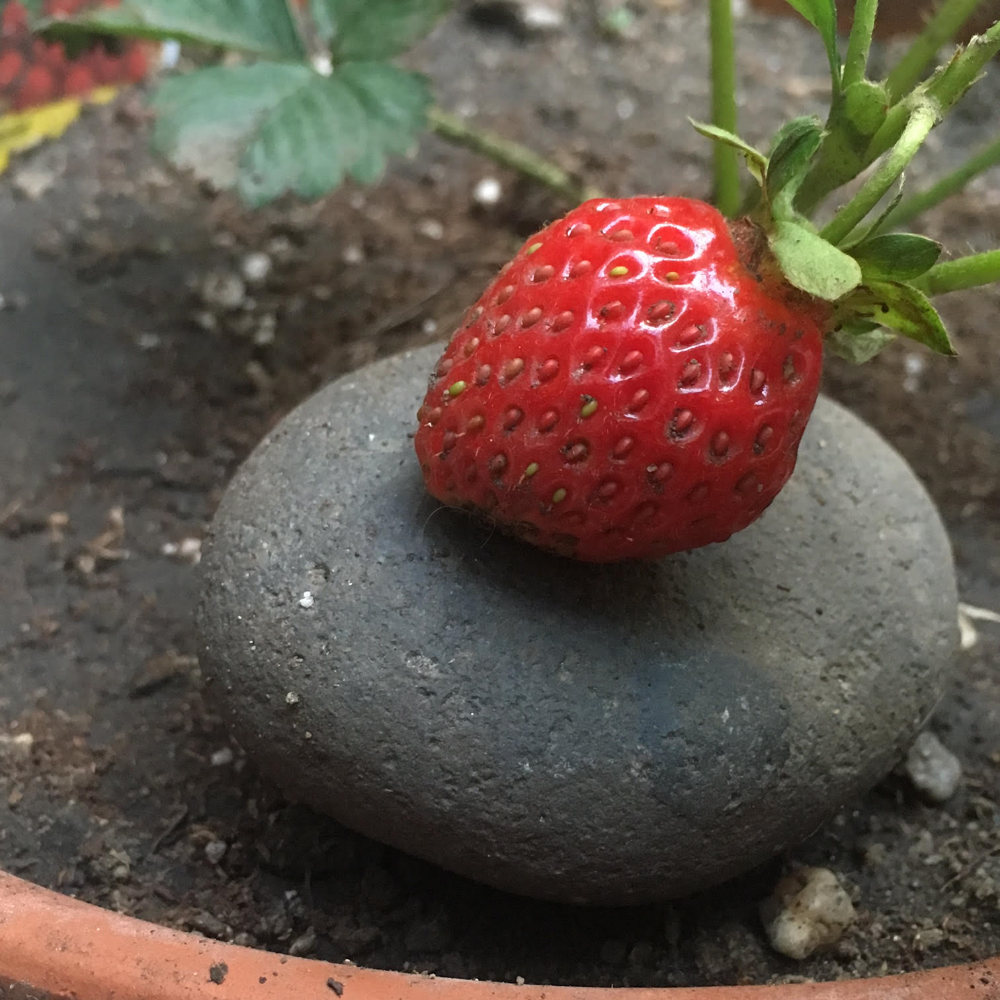
I recently planted a small garden in front of my home. It’s nothing fancy, not yet at least, but it’s my new favorite hobby. When I’m gardening, I just get in the zone. I forget all about the outside world, and it’s just me and the earth. Digging in the dirt, tending to the different plants, watering them and watching how they grow makes me feel content, relaxed, and purposeful.

A strawberry from my garden... it's teeny tiny!
Whether it’s gardening, weight lifting, coloring books, yoga, hiking, painting, cooking, collecting, puzzling, woodworking, playing a musical instrument, bird watching, rock climbing, surfing, skiing, dancing, fishing…. WHATEVER! Having a hobby allows you to completely focus on just one thing. Most of us spend our lives focusing on a million things at once. But when you get into your hobby, you forget about your busy, crazy life, and just live in the moment.
There is actually a word for what you are doing: it’s called mindfulness. And there is some crazy science to back it up.
When you are being mindful, you are purposefully paying attention to one thing. You aren’t being judgmental. You aren’t worrying about the future. You aren’t thinking about the past. You are just being. When you get in a state like this your brain activates.
Activation is a really good thing because it helps grow, strenghthen, and connect certain areas of the brain.
Most of the researchers who study mindfulness observed people who practiced mindfulness for at least eight weeks in the form of meditation, yoga, or mindfulness based stress reduction. By comparing MRIs of mediators and non-mediators, we know that there are two main areas of the brain that get activated from mindfulness.
The first is the prefrontal cortex, which is responsible for higher cognitive functions like planning, decision-making, and judgment. The second area is called the insula, which is important for empathy, love, and self-awareness. MRIs also showed increased gray matter density in the brains of mediators. Grey matter is the area where most of the actual brain cells live, and the more dense the matter, the more the cells are able to form connections with each other, thereby giving you a more powerful brain. When you continue practicing mindfulness, AKA keep doing your hobby, the overall structure of your brain adapts to the activated state and experiences lasting improvements in the way you function.
I won’t continue listing boring facts about the brain, but if you want to read more you can click here or here. All you need to know for now is having a hobby is REALLY good for you because it strengthens parts of the brain that are crucial for helping us function in the world.
Here are some evidence-based examples of things that might happen when you commit to a hobby:
1. Your brain activity will develop in a way that leads you to have more resilient and less destructive thinking patterns.
2. Your immune system will drastically improve (even if you have HIV or cancer!)
3. You will notice an improvement in your mood, decrease in stress, and decrease in depression.
4. You will have less anxiety.
5. You will feel more empathetic.
6. You will gain a greater sense of self-control.
7. You will find an internal sense of stability and clarity. (Bonus: If you have ADHD you may notice more improvements in your attention from practicing mindfulness than from taking medications.)
8. If you have ruminating thoughts, impulsive behaviors, or repetitive destructive emotions, it will become easier for you to discern mental chatter from your regular baseline state.
9. If you have severe depression, the likelihood of your depression recurring will decrease by HALF.
10. You will notice an overall improvement in your physical and emotional well-being.
If you think having a hobby is a luxury or something you should only do as a reward, think again. Dedicating one hour a day to a simple hobby can immensely improve your life, physically, emotionally, and spiritually. Mindfulness is something that anyone can do, any time, anywhere. If you want to learn more about mindfulness, or would like assistance incorporating some of these tactics into your life, reach out to me. I want to help. For more information or to book an appointment, please call 203-273-5950 or email me at amanda@amandajablon.com.
Amanda Jablon, MSW, ACSW, is an associate clinical social worker in private practice in Los Angeles, supervised by Ken Howard, LCSW, #LCS18290. She works with a wide variety of clients, but specializes in the special needs of millennials and in individuals who need help moving beyond the past.

F--- the Power of Positive Thinking: A Guide To Greener Pastures for the Dark Minded Individual
Everyone tells you you’re looking at things the wrong way. That you should just be optimistic. As if you were to smile and do yoga everything would be sunshine and rainbows. Well f--- those people. You’re not that kind of person.

Photo: Peter Kramer/NBC/NBC NewsWire
In my experience, there are three types of thoughts that make someone feel like they are “not that kind” of person.
1. You know about the evils of the world. Maybe you were shielded from it as a kid (or maybe you were not), but you’ve long since learned how ugly people can be. To ignore that knowledge would be to forget about those experiences and silence your truth. A truth that instinctively protects you from harm.
2. You know better. If you look at things optimistically, you are only setting yourself up for greater disappointment.
3. You are a realist. Optimism is not reality. Nobody can be happy all the time. Maybe you just want to feel whatever it is you are feeling.
Good or bad, your feelings are ALWAYS valid. It’s science.
Let me explain.
Imagine you are a cave person… on a tropical island… drinking a Mai Thai … suddenly you see a bear! You feel afraid. Your brain sends signals to your body that sends you into fight or flight mode. At this moment you are completely and utterly aware of three options and three options only: you can fight the bear, you can run away, or you can play dead. Fear in this case has a really important biological purpose. By limiting the choices you have in dealing with the bear, you get hyper focused on the task of surviving. Thanks to fear you get to live and finish your Mai Thai.
The problem with modern biology is that we are no longer running from bears, but our brains have not yet caught up to our progressive lives. So whenever you experience a negative emotion (fear, sadness, anxiety, etc.) your brain responds by solely focusing on the task at hand and shutting everything else down. So whether you are anxious about a poor review at work, angry because you are in a fight with your partner, or running from wild animals, your brain does not care… negative feelings = bear.
I think most of the reasons we choose not to think optimistically stem from encountering so many bears. We eventually become afraid of having more bad feeling experiences, dread being disappointed, and we even use reality as a reason to validate our fear. It’s important to understand that fear is actually something to be grateful for, because it’s the body’s natural way of protecting us. We just have to learn to ignore it every once in a while so we don’t hold ourselves back.
The biology of positive emotions is interesting because it actually works in the complete opposite way of negative emotions. One research study looked at the way positive emotions work by examining doctors’ abilities to solve problems. The researchers simulated positive feelings by giving the doctors some candy and then asked them to think out loud while analyzing a case. The doctors who felt good were able to think about problem solving in a really broad and expansive way. They were clear-headed, organized, open-minded, drew on a wide span of information, didn’t get stuck on their initial thoughts, and were less likely to make a premature diagnosis.
Essentially, when you think with a positive mind, you give yourself opportunities. When you think with a negative mind, you limit your potential.
This actually means that you have a huge amount of control in creating the outcomes in your life, just by altering the way you think.
If you are finding yourself thinking that this information just does not apply to you, that there is no hope for you, that you have always seen the worst, that is quite simply not true. Science has figured out that brains have this thing called plasticity, which basically means that old dogs can and do learn new tricks!
These are not just my opinions, kids. This is science. Cold. Hard. Science.
So we know the grass is greener, but how do we get and stay on the other side?
Let me preface by saying that I don’t think optimism is a natural thing. Negative emotions are just stickier and heavier than positive ones. So you basically have to figure out a way to override your body’s natural system. You just have to work for it. Like really hard. And actually commit to the process.
It’s like going to the gym when you haven’t gone in a while. The first time you get on the treadmill you’ll feel really sore and want to quit. But when you keep practicing your muscles develop, you feel stronger, the practice feels more familiar, and thus it gets easier.
You have to be willing to surrender fear. You have to be willing to fail. You have to be willing for your expectations to be wildly murdered. You have to accept that learning to think in this way will not eliminate your negative feelings or struggles. And you’ll probably even feel stupid while doing it. Learning to think optimistically isn’t easy. It’s just worth it.
There’s an Einstein saying that insanity is doing the same thing over and over again and expecting different results. You cannot realistically expect to have a good quality of life some day if you are perpetually focusing on negativity. If you want to get out of feeling stuck in negativity and start moving toward a more positive life, but need a little guidance, please reach out to me. I am here to help. For more information or to book an appointment, please call 203-273-5950 or email me atamanda@amandajablon.com.
Amanda Jablon, MSW, ACSW, is an associate clinical social worker in private practice in Los Angeles, supervised by Ken Howard, LCSW, #LCS18290. She works with a wide variety of clients, but specializes in the special needs of millennials and in individuals who need help moving beyond the past.

They Fail Too
I like watching people make pottery. I’ve never actually done it myself, but there is something mesmerizing about watching someone create an intricate shape from a blob of mud (see, Tortus-Copenhagen). The clay spins atop a wheel and endures struggle from the pressure of the potter’s hands, which allows its shape to change. It shifts by shrinking and growing and ultimately it becomes a beautiful design.
People are similar to pottery in many ways. We shrink and grow, and our struggles lend us experiences that make us beautiful. But we are inherently different because we do not arrive at a final destination as a transformed masterpiece. We are ever growing, ever changing beings with beating hearts and feelings. We are not beautiful because we transform into something, we are beautiful because we are always transforming.
When we share parts of ourselves on social media, we usually display ourselves like a finished piece of pottery. We typically leave out the parts about struggle and failure. This way of sharing does make sense because we generally want to feel good and share good feelings. It’s just not entirely realistic. Everybody struggles. Everybody fails. So sharing only our successes is problematic because it creates a breeding ground for unnecessary and painful comparing.
Social media more than any other platform allows us to compare our insides to others outsides. We see an image on a screen. A momentary snap shot. And then we create stories in our minds about how they got to be that way, imagining and fantasizing it was a better road than ours. We push ourselves down by doing this because we mentally discard the possibility that they too have struggled or are currently struggling.
Here are some examples...
What you see: I graduated college! I am so grateful for my friends and family who have supported me on this journey and excited to see what lies on the road ahead!
Reality: I failed math and had to retake it over the summer in order to graduate. I also have no idea what career path to follow and am nervous that I have not yet found a job.
What you see: I am so excited to officially announce my new promotion at work!
Reality: My boss has treated me terribly for years in a job for which I was over qualified and I didn’t think I would ever move forward. I’m probably still not getting paid fairly.
What you see: We had a baby and are so in love with our bundle of joy!
Reality: We struggled with infertility and have spent his college savings fund on creating him.
It’s time to stop comparing our entire beings to one moment on a still frame. You will never be that person on the screen. And that person will never be you. Comparing does not lift you up. It does not strengthen you. You are a handcrafted piece of art, not a machine made object. The treasure of owning a piece of handmade pottery is the knowing that your item is unique. . Knowing that it is impossible for someone else to have what you own. We need to create space to share freely while embracing ourselves (and others!) wholly.
When you choose to look inward instead of comparing, you will allow yourself an opportunity to truly learn about YOU. From that place you can truly grow, and become the person you want to be, not the person you feel others think you should be.
If you are interested in doing this work, in bravely looking inward and seeing how you might grow with help and support, reach out. I am here to help. Let's see what kind of work we can achieve together. For more information or to book an appointment, please call 203.273.5950 or email me at amanda@amandajablon.com.
Amanda Jablon, MSW, ACSW, is an associate clinical social worker in private practice in Los Angeles, supervised by Ken Howard, LCSW, #LCS18290. She works with a wide variety of clients, but specializes in the special needs of millennials and in individuals who need help moving beyond the past.