This Pride Month, Be Queer and Spiritual. (Whatever That Means to You.)
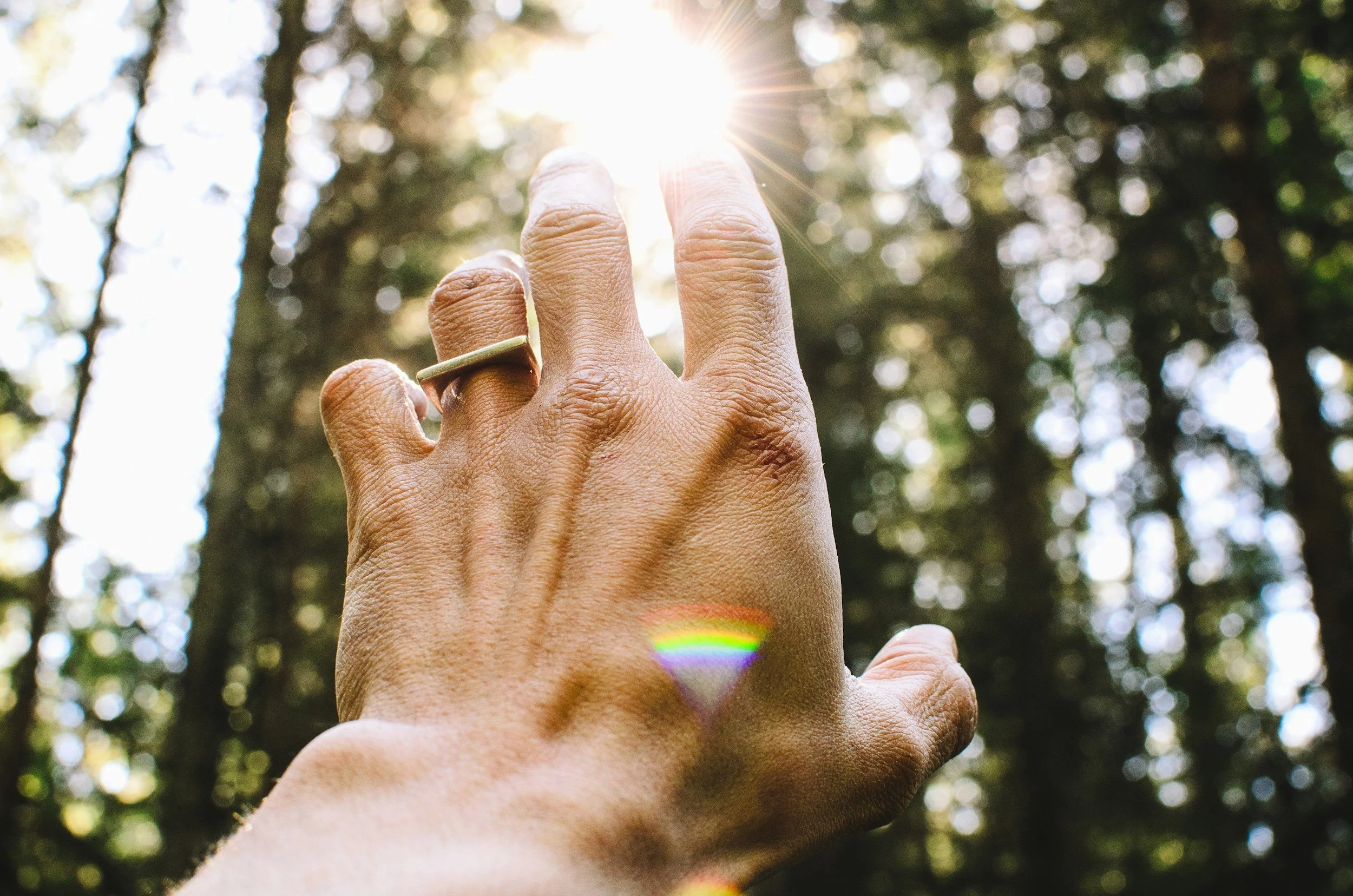
When religion has been used against you, walking away from it entirely makes complete sense. For many queer, transgender, non-binary, and gender diverse people, and for people whose relationships don’t look the way the church said they should, organized religion was not a place of welcome. It was a place where who you are was treated as something to be fixed, prayed over, or quietly tolerated at best. Leaving was an act of self-preservation. And for a lot of people, spirituality got left behind too, not as a conscious decision, but because the two had become so entangled it felt impossible to separate them.
Some people land on atheism after leaving, and that is a completely valid place to be. If that is where you are, this post is not trying to move you anywhere. Where you have landed deserves respect, not redirection.
But for people who rejected spirituality primarily as a reaction to religious harm, who closed a door without fully knowing what was on the other side of it, this post is an invitation to look again. Not at religion. At something that was always separate from it, and that nobody ever had the right to take from you.
Research on Why it Matters
Before we go any further, it is worth saying why this even matters from a mental health perspective. Because this is not just about personal meaning or philosophical preference. There is a real clinical reason to pay attention to spirituality, and it shows up consistently in the research.
Studies on treatment outcomes across anxiety, depression, trauma, and addiction recovery have found that people who have some connection to something larger than themselves, whether they define that as a higher power, the universe, nature, community, or simply a sense of meaning that extends beyond the individual, tend to fare better. They report greater resilience under stress, stronger ability to find meaning in difficult experiences, lower rates of depression and suicidality, and better recovery outcomes overall. The research does not require a specific belief system or tradition. What seems to matter is the connection itself, the sense that life holds some form of meaning and that you are part of something beyond just yourself.
For queer people and gender diverse people who were told their identity disqualified them from that kind of connection, this matters a lot. Because the research is not describing something that belongs only to people whose lives fit a certain mold. It is describing a human capacity that is available to everyone, in whatever form actually resonates.
A note on sources Research in this area includes work by Harold Koenig at Duke University’s Center for Spirituality, Theology and Health, as well as studies published in journals including the American Journal of Psychiatry and Psychological Medicine. The relationship between spirituality and mental health outcomes is one of the more robust findings in the field.
Religion and Spirituality Are Not the Same Thing
Religion is an institution. It has structures, doctrines, hierarchies, and rules. It exists inside buildings and organizations and communities with specific beliefs about who is in and who is out. For many queer and gender diverse people, and for people whose relationships don’t fit the traditional mold, organized religion has been a place of real harm. That harm is worth naming honestly and not minimizing.
Spirituality is something different. It is personal. It is the part of human experience that reaches toward meaning, toward connection, toward something that feels larger than the individual self. It does not require a building or a doctrine or anyone’s permission. It does not have a membership list or a set of rules about who qualifies. It belongs to you in a way that no institution can grant or revoke.
For people who grew up religious, these two things can feel so intertwined that losing one feels like losing both. If church was where you learned to pray, it can feel strange to pray without it. If community worship was the only container you ever had for spiritual experience, it can feel like there is nowhere to put that part of yourself once the community is gone. But the container and the content are not the same thing. The longing for meaning, for connection, for something sacred, that did not belong to the institution. It belonged to you all along.
And for people who have arrived at atheism or agnosticism after leaving, that too can be a spiritual position in the broadest sense. A deep commitment to human connection, to ethical living, to finding beauty and meaning in the world as it is, is its own relationship with what matters. There is no single word that needs to go on it. You are allowed to explore what meaning looks like for you without having to land anywhere in particular.
Leaving a religion that harmed you is not the same as losing your spirituality. You took that with you when you left. It was always yours.
Grieving the Community Without Grieving the Whole Thing
One of the things that makes leaving a religious community so complicated is that it is rarely just theology that gets left behind. It is people. Ritual. A calendar built around meaning. A framework for understanding suffering and joy and what life is for. A sense of belonging to something larger than yourself. Those losses are real, and they deserve to be grieved rather than minimized.
What I want to offer is the possibility that grief for the community and aliveness in a life of meaning can exist at the same time. You do not have to be finished grieving before you are allowed to explore what comes next. You do not have to have it all figured out. A meaningful life outside of institutional religion can look like a lot of different things, and most of them involve uncertainty and finding your way slowly, which is actually not so different from how the best things in life tend to go.
For queer people and gender diverse people and people in non-traditional relationships, there is something else worth saying here. The community you find on the other side of leaving, chosen family, queer community, people who know exactly who you are and love you without condition, that is its own form of the sacred. The belonging you find there is not a lesser version of what you lost. For a lot of people, it turns out to be more.
Reclaiming A Meaningful Life for Yourself
There is no single right way to build a spiritual or meaningful life outside of religion. That is the whole point. Some people find their way to affirming faith communities, churches and congregations and spiritual spaces that have done the work of genuinely welcoming queer and trans and gender diverse people and non-traditional families. Those spaces exist and they matter and if that is what you are looking for, it is worth looking.
Some people build something quieter and more personal. A practice of meditation or contemplation. Time in nature that feels like something more than exercise. A relationship with what feels sacred or meaningful that is entirely their own, with no intermediary and no doctrine and no one else’s definition of who is allowed to show up. That is legitimate. It does not need anyone’s validation to count.
Some people find meaning in community itself. In the depth of their relationships, in the particular intimacy of a chosen family, in the way loving people well feels like participation in something important. For people whose love lives outside the traditional box, whether that means loving someone of the same gender or loving more than one person or structuring relationships in ways that fit who they actually are, there is something genuinely radical and genuinely beautiful about insisting on love anyway. About building a life around connection and honesty and chosen commitment in a world that has not always made that easy.
That is not a lesser way to live. That might be exactly what it looks like to be close to what matters.
Being queer and building a life of meaning on your own terms is not a contradiction. For a lot of people, it turns out to be one of the most honest ways to be alive.
Something Worth Celebrating
Pride Month is about a lot of things. Visibility, history, community, joy. It is also, at its core, about the radical act of being fully yourself in a world that has spent a lot of energy trying to talk you out of it.
Deciding that your sense of what is sacred or meaningful belongs to you and not to the institution that tried to use it against you is an act of reclamation. Building a relationship with meaning and connection on your own terms, in your own language, in a life that actually looks like who you are, that is not a compromise. It is a form of freedom that a lot of people never get to experience, and that you have earned.
You do not have to have it all figured out. You do not need a label for what you believe or a tradition to belong to or a tidy answer when someone asks. Wherever you have landed is okay. And if any part of you is still curious about what meaning or connection or something larger than yourself could look like outside of what hurt you, that curiosity is worth following. Slowly, on your own terms, with no pressure to arrive anywhere in particular.
That is enough. That is more than enough. That is, honestly, something worth celebrating.
If you are navigating the intersection of identity and faith, or rebuilding a sense of meaning after leaving something that hurt you, I would love to be part of that conversation. Reach out and let’s talk.